

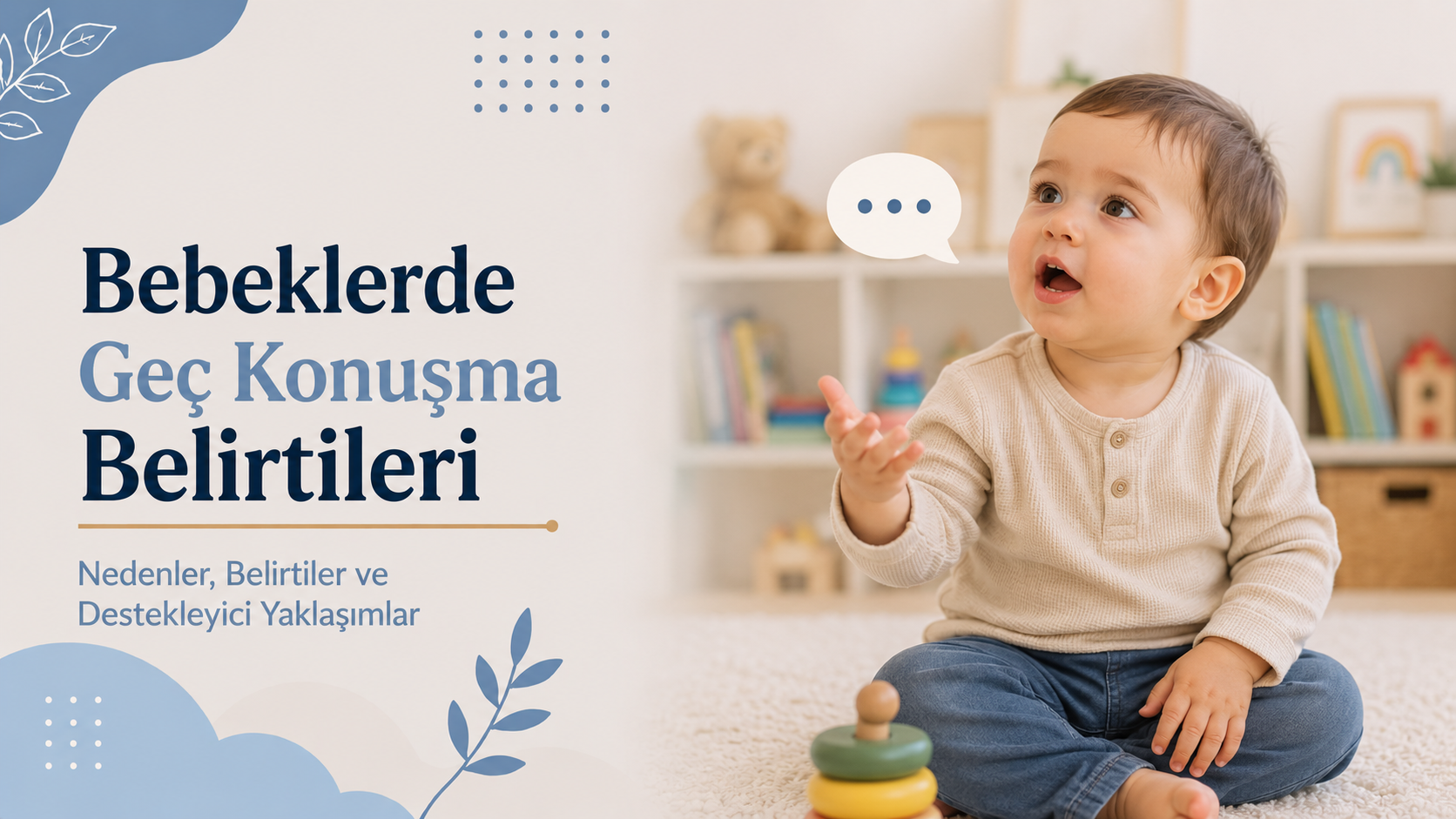
“Every baby’s developmental process is different. However, when significant delays in communication skills are identified early on, the support process can proceed more smoothly.”
What Are the Signs of Late Speech in Infants?
Signs of delayed speech in infants may manifest as difficulty developing the communication and speech skills expected for the baby’s age. While some infants may start speaking later, in some cases a developmental evaluation may be necessary.
Speech development is not limited to simply saying words. Making eye contact, responding to one’s name, using gestures, and showing a desire to communicate are also important areas that need to be assessed.
Every baby may develop at a different pace. However, if there are noticeable delays at certain developmental milestones, the situation should be carefully evaluated.
Early support may be particularly important when there is a lack of desire to communicate or when significant difficulties with social interaction are observed.
Signs of Delayed Speech in Infants by Age
Speech Development at Age 1
At this age, children typically begin to use single-word responses.
Experts may expect the use of basic words such as “mom,” “dad,” “mama,” “come,” “go,” “take,” or “give” during this period.
In some cases, the complete absence of these words may be considered a sign of delayed speech in infants.
Speech Development at Age 2
By the age of two, children’s vocabulary may begin to develop significantly.
Some children can form short, two-word sentences and begin to express their wishes more clearly.
If a child of this age still uses a very limited vocabulary or has noticeable difficulty forming sentences, a speech delay should be evaluated.
Speech Development at Age 3
Around the age of three, children’s speech may begin to become more understandable.
They can be expected to form simple sentences, express their needs, and communicate more actively with those around them.
It is important for parents to be able to understand most of what their child says, and for people outside the family to be able to understand a significant portion of the conversations.
“Speech development is not just about saying words; it is also the ability to understand, communicate, and express oneself.”
Areas to Pay Attention to in Late-Stage Communication
In some children, speech delays may be accompanied by difficulties in the areas of motor skills or sensory integration.
In particular, a limited desire to communicate, difficulties with imitation skills, or trouble understanding instructions should be carefully evaluated.
Identifying signs of delayed speech in infants at an early stage can help ensure that the support process proceeds more effectively.
How Can You Recognize Signs of Late Speech in Babies?
Signs of delayed speech in infants can manifest differently in each child. While some infants may only exhibit a speech delay, others may show a broader range of symptoms related to communication.
Common symptoms include:
- I don’t react when my name is mentioned
- Limited eye contact
- Limited use of gestures and facial expressions
- A significantly lower vocabulary size compared to peers
- Limited desire to communicate
- Repeating the same sounds over and over
- Having trouble expressing their wishes
- Low levels of imitative behavior
- Difficulty understanding simple instructions
- Staying on the sidelines in social interactions
If these symptoms persist for a long time and affect communication development, it is important to have them evaluated.
What Causes Delayed Speech in Babies?
Signs of delayed speech in infants can arise from many different causes. Developmental, environmental, or auditory factors may play a role in this process.
Hearing Problems
Hearing problems can directly affect speech development.
For this reason, the hearing process is also important when evaluating speech delay.
Insufficient Social Interaction
Babies’ speech development is closely linked to social communication.
Interactive communication and play can support language development.
Extensive Screen Exposure
Prolonged screen time may negatively affect communication development in some infants.
Face-to-face communication is particularly important during early childhood.
“Language development isn’t just about learning words; it’s also the ability to communicate with others.”
Developmental Differences
Some children may need more support with their speech and language development.
For this reason, not only speaking skills but also general communication skills should be evaluated together.
What Can Be Done About Signs of Late Speech in Infants?
When signs of delayed speech are observed in infants, it is important to create a safe and communication-focused environment.
Stay in Close Contact with Your Baby
Speaking, naming objects, and engaging in two-way communication in everyday life can support language development.
Responding to your baby’s sounds can boost their motivation to communicate.
Play Games Together
Interactive games can help develop social communication skills.
Imitation games can be particularly helpful, especially in the early years.
Limit Screen Time
It is important to increase face-to-face communication rather than relying on extensive screen time.
Real social interaction may be more effective in language development.
Support Book and Story Projects
Age-appropriate books and visual aids can support a baby’s language development.
Reading books together can strengthen the communication process.
Behaviors Families Should Avoid
Some approaches can inadvertently hinder communication development.
- Constantly comparing your child to others
- Allowing extensive screen time
- Ignoring communication efforts
- To consistently adopt a high-pressure approach
- To embarrass someone for not speaking
- Meeting their needs immediately without any communication
- Displaying an anxious or panicked attitude
A patient and supportive approach can have a positive impact on a baby’s communication development.
When Should You Seek Professional Help?
If signs of delayed speech in infants persist significantly and are affecting their communication development, an evaluation by a specialist may be helpful.
It may be advisable to seek support in the following situations:
- If there is a noticeable difficulty in responding to one’s name
- If there is a significant delay in language development
- If eye contact is limited
- If social communication skills appear to be weak
- If they have trouble understanding simple instructions
- If the desire to communicate is noticeably low,
Receiving support early on can help foster healthier communication development.
Can Delayed Speech in Babies Be Corrected?
In some children, speech development may accelerate over time. However, every child’s needs are different, and an individual assessment is important.
In infants where signs of delayed speech are detected early, this can help ensure that the support process progresses more effectively.
A patient, supportive, and communication-focused approach can positively support the baby’s developmental process.
Get Professional Support
If you think your baby is showing signs of delayed speech, it’s important to seek support early on.
👉 To contact us via WhatsApp,
Click here.
👉 For more information
You can visit our Contact Us page.


